The Semantic Layer Is the New API for AI Agents

Key Takeaways
AI agents don’t hallucinate because models are bad. They hallucinate because your data has no shared vocabulary. Three columns named “revenue” in your warehouse, three different meanings — and the agent picks one with perfect confidence.
The semantic layer is the missing infrastructure. It sits between raw tables and every consumer (dashboards, APIs, agents) to define what business terms mean, how they’re calculated, and who can use them.
Gartner’s prediction is direct: organizations that prioritize semantics in AI-ready data will increase agentic AI accuracy by up to 80% and reduce costs by up to 60%.
It’s been a while since I wrote here. Between running agentic AI programs across ASEAN and watching every vendor slap “AI-ready” on their marketing deck, the urge to write something honest about data foundations got strong enough to break through the schedule. So here we are — cutting through the noise to talk about something boring-sounding but genuinely important: the semantic layer.
Your “Revenue” Problem
Every enterprise data team eventually faces the same question: “What does ‘revenue’ mean here?”
The room goes quiet. Then three people give three different answers.
Finance says net of returns. Sales says gross bookings. Product says MRR. The warehouse has columns named revenue, total_revenue, and adjusted_revenue — nobody documented the difference when the intern created them in 2019.
For fifteen years, this was fine. Humans compensated. Your VP noticed “that number looks off,” called the analyst, spent Tuesday reconciling dashboards. Slow, expensive, but eventually correct.
Then we connected AI agents to the same data.
An agent doesn’t call the analyst. It picks one column, builds a confident answer, and serves it to the CEO. The silent disagreement in your data just became a production incident — and nobody caught it until the board deck didn’t match the audited financials.
This is happening in every large enterprise I consult. Not because the AI models are bad. Because the data underneath has no shared vocabulary.
What the Semantic Layer Actually Does
A semantic layer is where you define what business terms mean, how they’re calculated, and who gets to use them. It sits between raw tables and everything that consumes data — dashboards, notebooks, APIs, AI agents.
Instead of every team re-implementing “monthly active users” from raw event tables (and getting slightly different numbers), they query the semantic layer. One definition. One calculation. One answer.
Think of it as the difference between giving someone a dictionary versus giving them a pile of letters. The letters are all there — but without definitions, you’re assembling words by guessing.
For the past decade, this was a BI convenience. Looker’s LookML was an early version. dbt’s metrics layer pushed it further. But in 2026, Gartner elevated it to essential infrastructure — not because the concept changed, but because the stakes did.
Their prediction is direct: organizations that prioritize semantics in AI-ready data will increase agentic AI accuracy by up to 80% and reduce costs by up to 60%. (Gartner, May 2026)
Eighty percent. Not a marginal improvement — the difference between a system that ships and one that gets shelved.
”But We Already Have a Data Catalog”
The most common pushback. If we have a catalog, why do we need a semantic layer? And while we’re at it — how is this different from data governance?
They’re related. They’re not the same. Here’s the simplest breakdown:
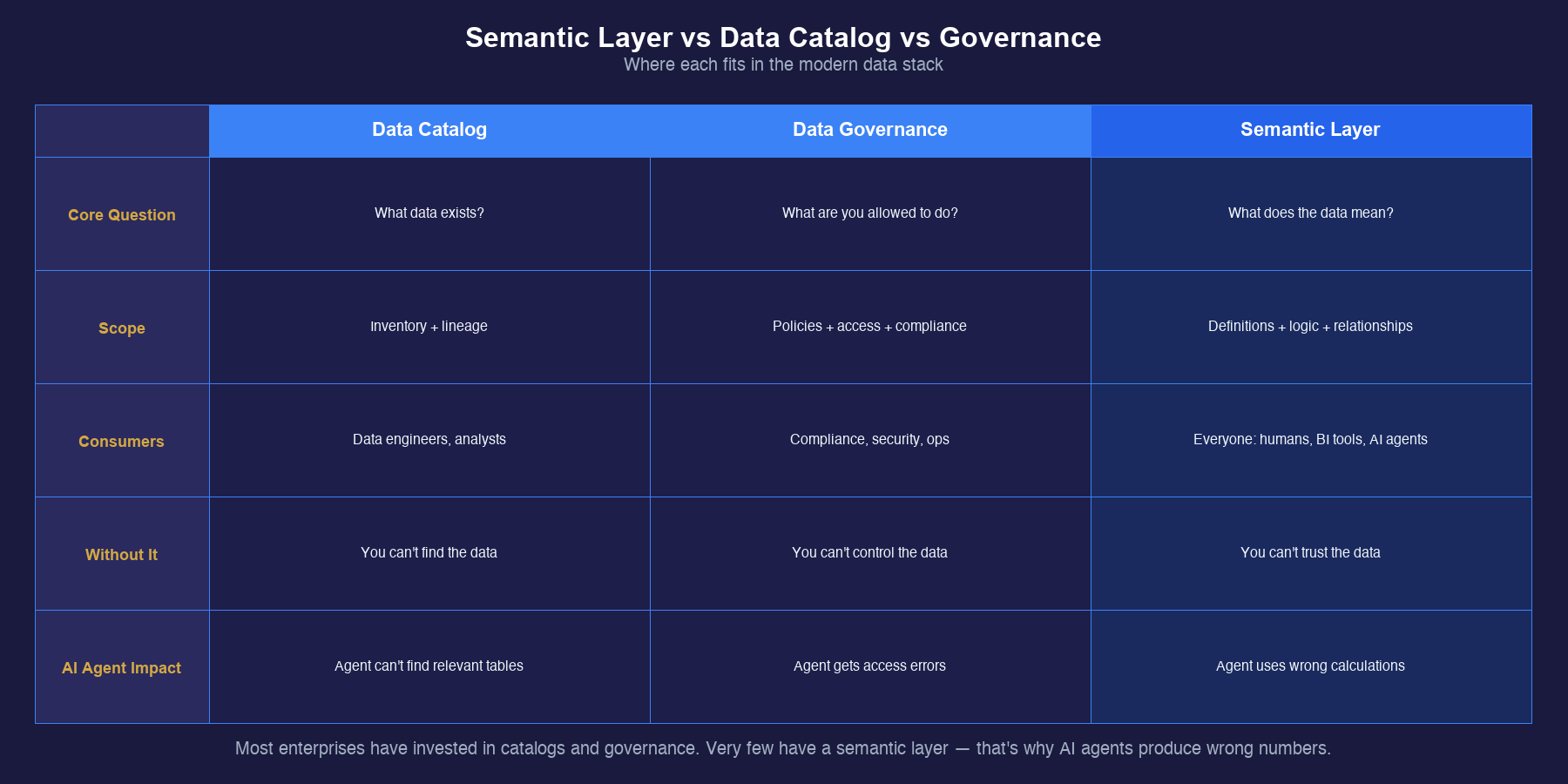
A data catalog tells you what data exists. It’s inventory. Tables, columns, owners, lineage, tags. It answers: “Where is the customer table? Who owns it? What flows into it?” Think of it as a library card catalog — it tells you which shelf the book is on, but it doesn’t explain what the book means.
Data governance tells you what you’re allowed to do. Policies, access controls, classification, retention. It answers: “Can this team access PII? How long do we keep this? Who approved this change?” It’s the library’s rules — who can check out which books, and what happens if you lose one.
A semantic layer tells you what the data means. It answers: “What is ‘revenue’? How is it calculated? What filters are valid? What’s the grain?” It’s the actual content of the book — the definitions, the logic, the relationships between concepts.
Here’s the practical difference: your data catalog might tell you there’s a column called monthly_revenue in the finance.summary table, owned by the finance team, classified as confidential. Your governance framework ensures only authorized roles can query it. But neither tells you whether that number includes or excludes refunds, whether it’s accrual or cash-basis, or whether it should be filtered by is_active = true before use.
That’s the semantic layer’s job. And it’s the gap that kills AI agents.
The punchline: most enterprises in 2026 have invested heavily in catalogs and governance. Very few have a semantic layer. That’s why their BI dashboards disagree with each other and their AI agents confidently produce wrong numbers.
Why Agents Need This More Than Humans
Humans tolerate ambiguity. When you see a number that looks wrong, you pause, ask questions, check another source. You carry institutional memory — you know that the sales dashboard inflates revenue because it counts renewals differently.
AI agents don’t pause. They don’t carry institutional memory. They query whatever they can find, construct an answer, and present it with perfect confidence. An agent doesn’t know that revenue in finance.monthly_summary excludes returns while revenue in sales.pipeline includes them. It picks one based on which schema looked most complete. Acts on it. Wrong.
At a financial services company in Bangkok, an internal AI agent used for customer reporting pulled from a cached pricing table that hadn’t been updated in three months. The agent’s “current” portfolio values were stale by millions of baht. Nobody caught it for two weeks because the numbers looked reasonable — they were just from the wrong point in time.
With a semantic layer, that table would have carried freshness metadata. The agent would have known the data was stale and either refused the query or added a caveat. Without it, the agent was confidently wrong.
The Architecture
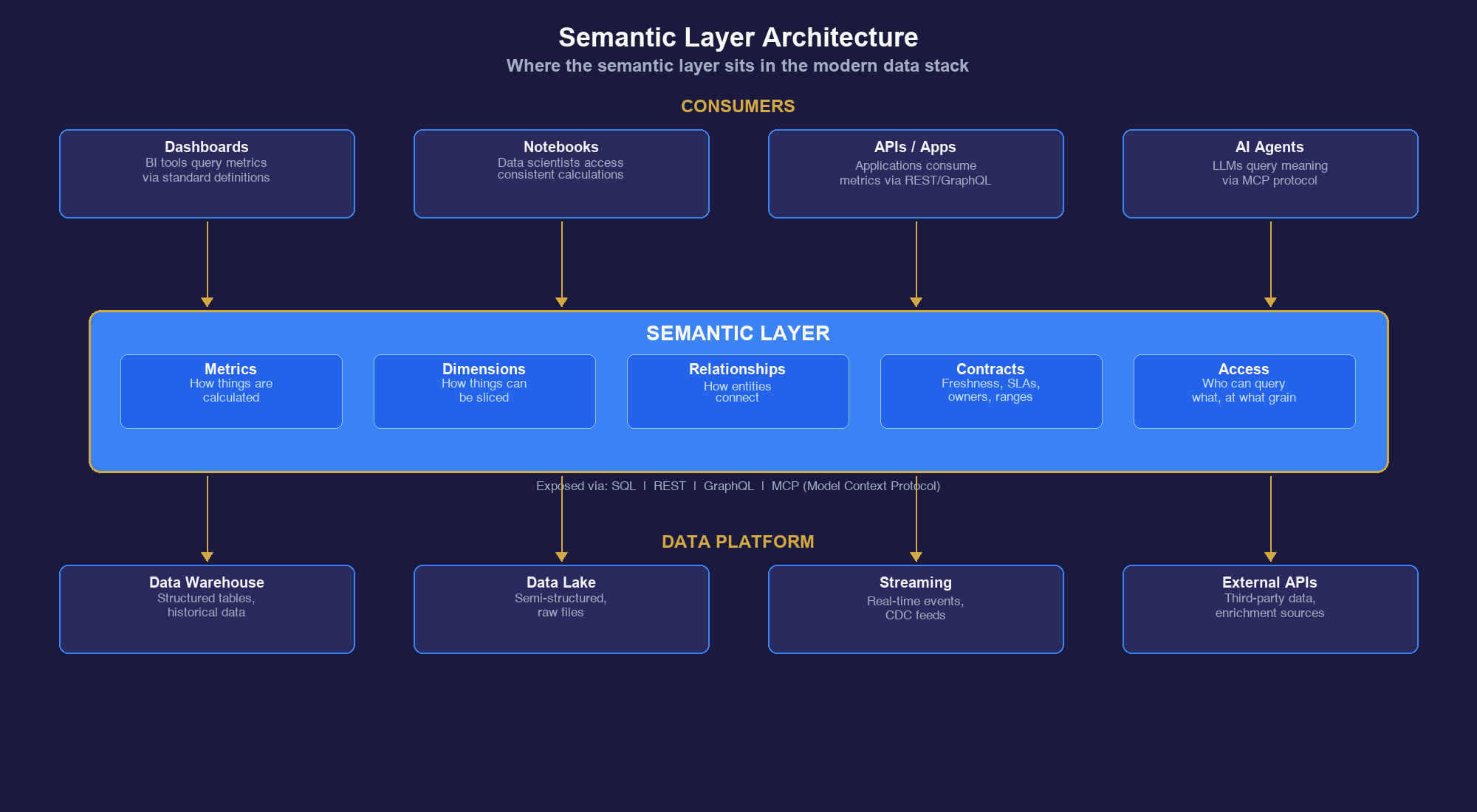
The semantic layer sits between your data platform and your consumers. Below it: raw tables, warehouses, lakes, streams — the physical reality. Above it: dashboards, notebooks, APIs, AI agents — the consumers who need answers.
The layer itself holds:
- Metrics — how things are calculated (revenue = sum of order_value where status != ‘refunded’)
- Dimensions — how things can be sliced (by region, by quarter, by product line)
- Relationships — how entities connect (customer has many orders; order belongs to one product)
- Contracts — freshness SLAs, owners, valid ranges, deprecation flags
- Access — who can query what, at what grain
In 2026, the critical evolution is that semantic layers now expose these definitions over standardized protocols — SQL, REST, GraphQL, and increasingly MCP (Model Context Protocol). That means an AI agent doesn’t need to understand your warehouse schema. It queries the semantic layer the same way it would call any API: “Give me revenue by region for Q2, as defined by finance.” The semantic layer handles the translation to physical queries.
Cube, Atlan, Databricks Unity Catalog, and Salesforce Data 360 are all shipping this pattern. The semantic layer is becoming the API for meaning — queryable by humans through dashboards and by machines through protocol.
Real-World: A Thai Government Platform With 7M+ Users
At a Thai government digital platform I architected (7M+ users), we had dozens of microservices each with their own user activity definitions. “Active user” meant different things to different teams — one counted login, another counted transaction, a third counted any API call. Reports to the ministry contradicted each other quarterly.
We built a shared metrics layer (before anyone called it a “semantic layer”) that defined active user once: a user who completed at least one core transaction in the trailing 30 days. Every dashboard, every report, every API consumed that single definition. The quarterly reconciliation meetings disappeared. The minister stopped asking “which number is real.”
That was 2022, for human consumers. In 2026, the same principle applies to agents — but the stakes are higher because agents act autonomously on the answers they get.
If You’re Starting From Zero
Don’t try to define your entire data estate. Start with the five metrics your CEO asks about in every board meeting. The ones people argue over. The ones where three dashboards show three different numbers.
Define those precisely — calculation logic, source, grain, freshness, owner. Put them in a queryable layer. Connect one BI tool and one agent use case. Prove they agree.
Then expand. But never let a new metric ship without a semantic definition. That rule alone prevents the chaos from returning.
The models get better every quarter. Your data definitions won’t improve on their own.
Sources: