Switch Your Model Tomorrow. What Do You Lose?
Two AI tools, one question, two different ARPUs, because nobody wrote down what a user is. The fix is not a better model, and the five terms everyone uses for it are not interchangeable. A telecom worked example; the problem belongs to every industry.

Key Takeaways
Two of your AI tools will answer the same KPI question differently, and neither is broken. Nobody wrote down what the business means by the word, so each one guessed.
Five terms get used for the fix as though they were one thing. Taxonomy, ontology, knowledge graph, semantic layer, context graph. Three of them stack. Two do not. You already own a taxonomy, and probably half a knowledge graph.
My take: the model is the replaceable part and the meaning is the fortress. Most enterprise AI budgets are spent the other way round.
The business problem, before any of the vocabulary
Someone asks two of your AI tools the same question about ARPU, average revenue per user. The numbers come back different. Both look reasonable, both cite real data, neither is obviously wrong.
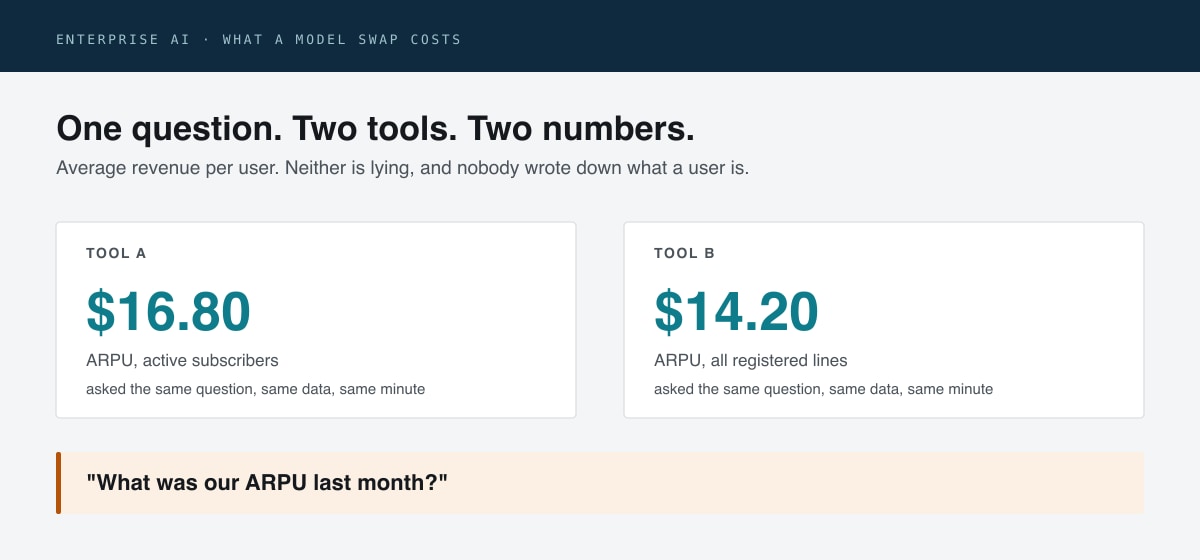
The same question, the same data, the same minute.
Nobody hallucinated. Each tool worked out for itself what a user was, and they worked it out differently, because the enterprise never wrote the definition down anywhere a machine could read it. One divided revenue by active subscribers. The other divided it by every registered line, including the ones suspended for non-payment.
The industry has not settled this either, which is why the acronym has a sibling. Plenty of operators report ARPA, average revenue per account, precisely because one account can carry five lines: a family plan is one customer or five depending on who is asking, and the two numbers can differ by a factor of three on the same revenue. Neither is wrong. They answer different questions, and nothing in the data says which question was asked. Ask five agents and you get five ARPUs, each defensible, none reconcilable.
The worked example here is telecom, because ARPU is unusually slippery: the denominator alone has four defensible readings before anyone reaches for ARPA. Nothing else about the problem is specific to it. Put margin in for a retailer, claims cost for an insurer, cost per patient for a hospital, and the rest of this article reads exactly the same.
It is not an AI problem. It is an old problem that AI made expensive, because the people who used to absorb it are no longer in the loop.
Almost everyone is here. CDO Magazine’s April 2026 benchmark puts only 14% of enterprises at “Scaled” maturity, with 81% in the middle two stages1, and its diagnosis is blunter than most boards expect: the constraint is incomplete governance, not lack of investment. The money is being spent. It is being spent in an order that does not compound.
The instinct is to fix it in the prompt. Write a longer instruction, explain what ARPU means, paste in the region list. It works, and it is the most expensive option available, because that knowledge is now welded to one model. Self-hosting does not save you. Open weights make the model yours; you will still upgrade, and the prompt is rebuilt every time.
So the meaning has to live outside the model. That is where the vocabulary starts.
Five words, five different jobs
These get used interchangeably in vendor decks. They are not interchangeable. Each answers a different question. Three of them stack. Two do not.
Taxonomy: where does this thing sit?
The oldest and the simplest. A tree: categories inside categories, each thing filed in one place.
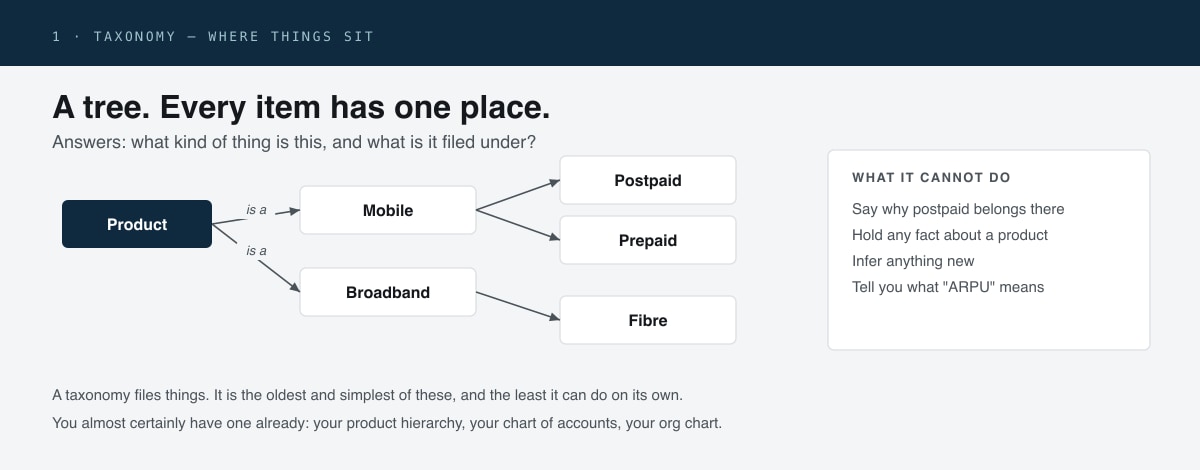
You already have several: your product hierarchy, your chart of accounts, your org chart. What it cannot do is hold a fact about a product, explain why something is filed where it is, or tell you what ARPU means.
Ontology: what is allowed to relate to what?
The grammar. It names the types of thing that exist and the relationships permitted between them, with rules a machine can check.
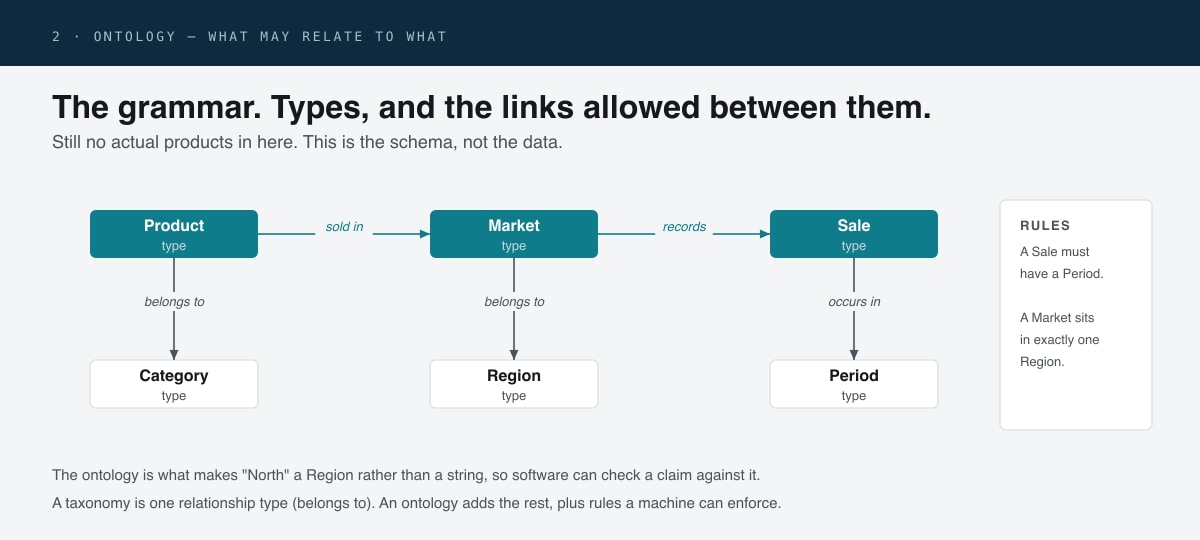
The schema, not the data.
A taxonomy has one relationship, belongs to. An ontology has as many as the business needs, plus constraints. “A Sale must have a Period.” “A Market sits in exactly one Region.” That is what makes “North” a Region rather than a string, so software can check a claim against it instead of trusting it.
Knowledge graph: the same shape, populated
The ontology is the blueprint. The knowledge graph is the building: real products, real markets, real numbers, connected by the relationships the ontology permits.
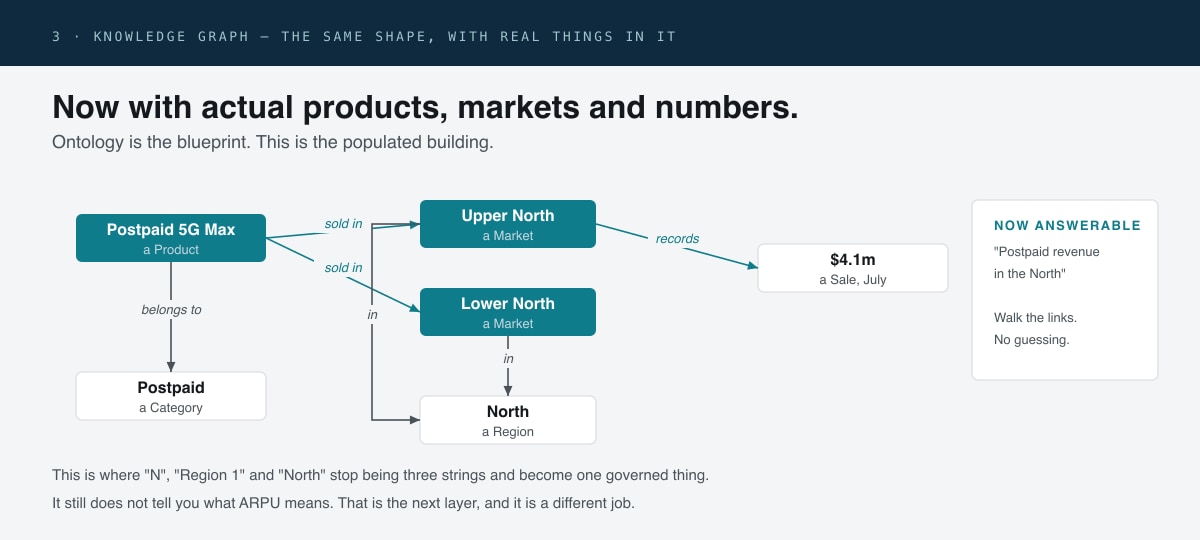
Where “N”, “Region 1” and “North” stop being three strings.
Now “postpaid revenue in the North” is answerable by walking the links rather than by guessing. Most enterprises have already half-built this and never connected it to anything, usually under the name master data.
Semantic layer: how is the number calculated?
A different axis entirely, and the one that stops the five-ARPUs problem. It maps physical columns to a governed business definition with an owner and a version.
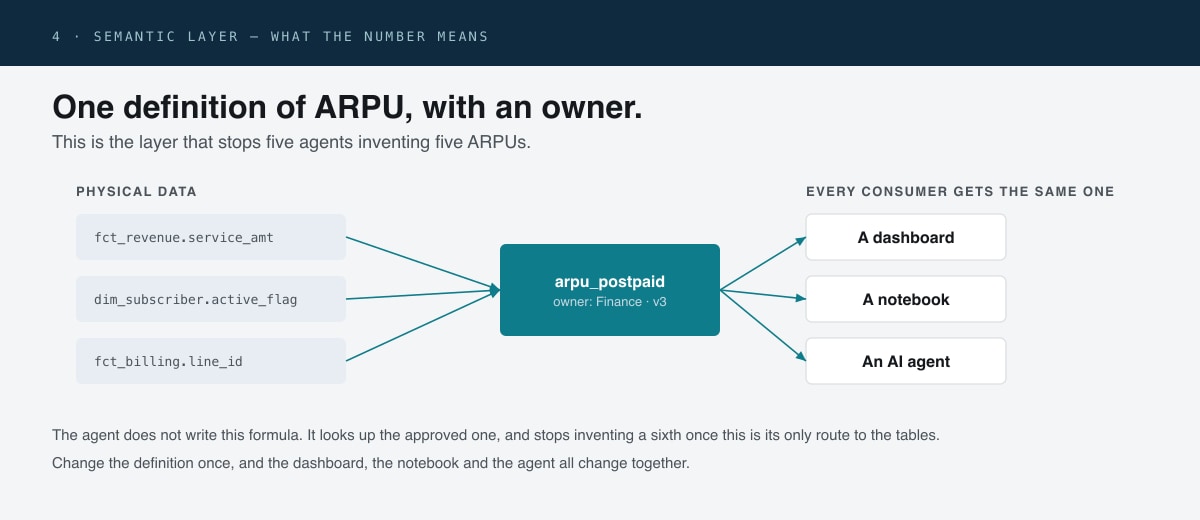
The agent looks up the approved definition. It stops inventing a sixth once this is its only route to the tables.
This is also why it needs none of the three layers above it. It can sit directly on a warehouse, which is why it is usually the cheapest of the five to start and the one that pays back first. Change the definition once and the dashboard, the notebook and the agent all change together.
Context graph: what does this conversation already know?
The newest term and the least settled. The other four are always-on infrastructure. This one is assembled for a single request and thrown away.
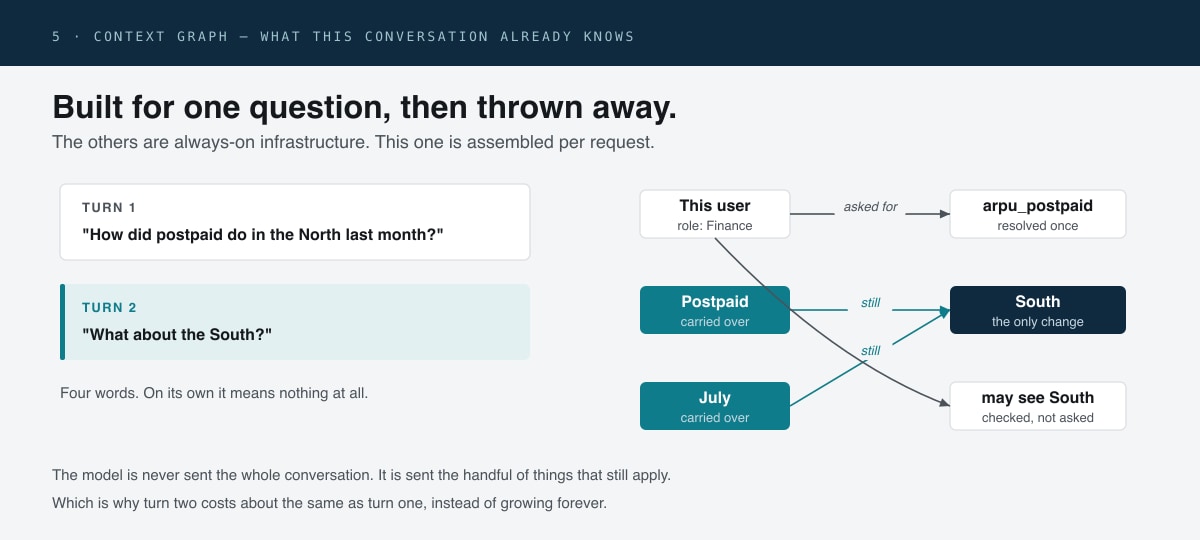
Something has to hold that the product and the period did not change and the geography did. Doing that as a structure rather than by resending the whole transcript is also why turn twenty does not cost twenty times turn one.
Is any of this data linkage? Partly, and the overlap is probably already funded. Record linkage decides that two records refer to the same real thing. The knowledge graph is where that resolved identity is kept, so a phrase in a live question can be matched to it instead of guessed at. If you have a master data programme, much of that layer is paid for, and connecting it is far cheaper than starting it. The semantic layer and the context graph are not data linkage and will not fall out of an MDM programme.
The worked example
Put them together and one question runs through all of them before the model does anything.

One replaceable box, and it is not the one holding your business meaning.
“Why did ARPU drop for postpaid in the North last month?”
Postpaid resolves to a category. The North resolves to a Region and its markets. ARPU resolves to the approved definition, version 3, owned by Finance. The conversation supplies July. Who is asking, and what they may see, comes from the session and is enforced again at the data layer.
Only then does the model get involved, and by then there is nothing left for it to guess about. Every resolution was a lookup in a system you own, so what the answer was built from is in your logs rather than in the model’s transcript: which definition ran, which records it touched, which permission was checked, and which model version answered. That last one is what makes the model replaceable at all.
A vendor slide with the model at the front, taking the raw question, is the other architecture. It will demo beautifully.
Three questions to ask this month
You need none of the vocabulary above to find out where you stand. Ask for a demonstration rather than an assurance.
One. Ask two AI tools the same KPI question. Live, in the room. If the numbers differ you have found the gap for the price of two minutes rather than an audit.
Two. Ask someone to show you where a business term is defined. Whether the definition sits in a system the agent must use, or in text an agent was asked to read. If the answer arrives as a screenshot of a prompt, that is your answer. Then ask to see the log entry from the last time an agent used it.
Three. Ask what a model swap would cost, and why. The reason matters more than the number. “Six weeks of model risk sign-off” is a well-run enterprise describing its controls. “We would have to rebuild what it knows about our business” is the problem in this article.

What a vendor change actually moves.
Pay once, or pay twice
Almost every expensive agentic AI initiative I have seen scaled the impressive thing first and the boring thing afterwards.
Scaling natural-language-to-data before the definitions exist means every team ships its own interpretation of ARPU. That is not a day-one bug. It surfaces when finance and operations bring two decks to the same meeting, and the reconciliation is work nobody put in a budget. You can price it for your own organisation without asking me: the people in that room, the weeks between the first disagreement and an agreed number, and the decisions that waited on it.
The benchmark shows this as a pattern rather than an opinion. Across the whole sample, 55% have adopted real-time AI policy enforcement, 43% have adopted data mapping, and 31% have formal vendor and third-party oversight1. The capability everyone wants is ahead of the foundations it depends on, which is the same inversion in the report’s own numbers.
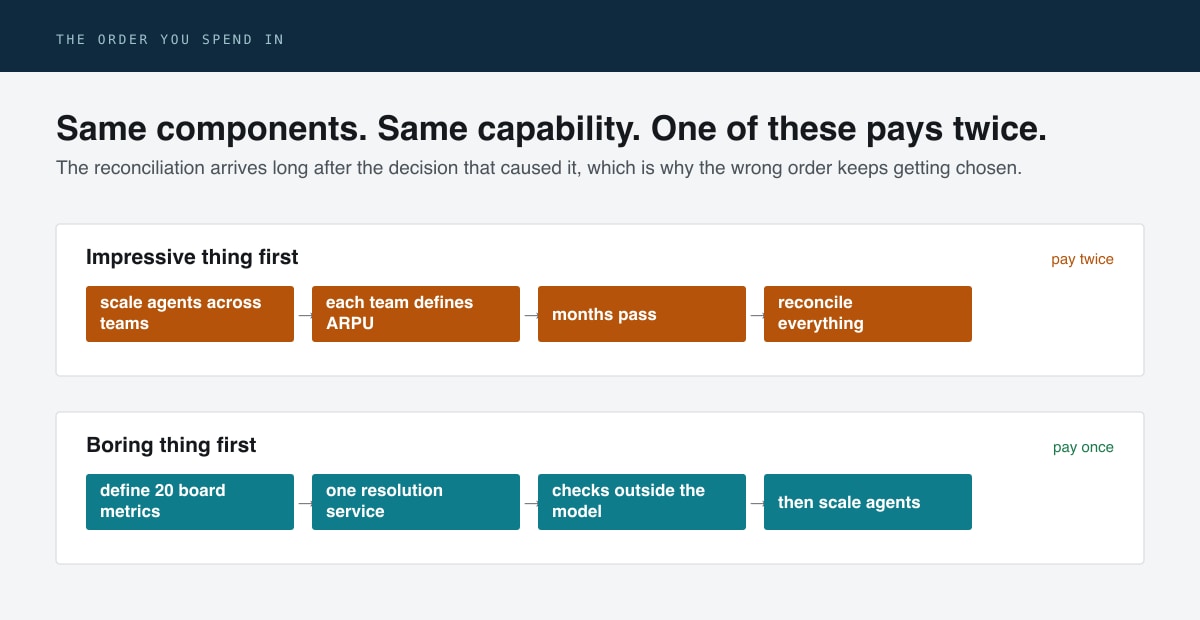
Same components. One order pays for them twice.
The cheaper order is unglamorous. Define the twenty metrics your board asks about. Connect the master data you already own. Make resolution a service every agent calls rather than a thing each agent reinvents. Put permission checks outside the model and enforce them again at the data layer, because an instruction is not a control.
Start there rather than with a platform programme, because the definitions hold their value whatever the model turns out to be in two years.
Your model is the replaceable part, whoever owns it. The meaning is the fortress.
1. Survey figures are from CDO Magazine’s vendor-sponsored Trend Report, “AI and Data Governance in the Enterprise” (April 2026).